BJORGXR
Every object in bjorgxr is alive. It has its own AI, its own memory, and its own appearance. You can talk to it. Ask it to change. It talks to other objects. It can become anything — a communication app, a database, a video game, an entire virtual world.
What is bjorgxr?
A platform where digital things are alive. Every object has its own AI, its own memory, and its own visual representation. They talk to each other. They can become anything.
How it works
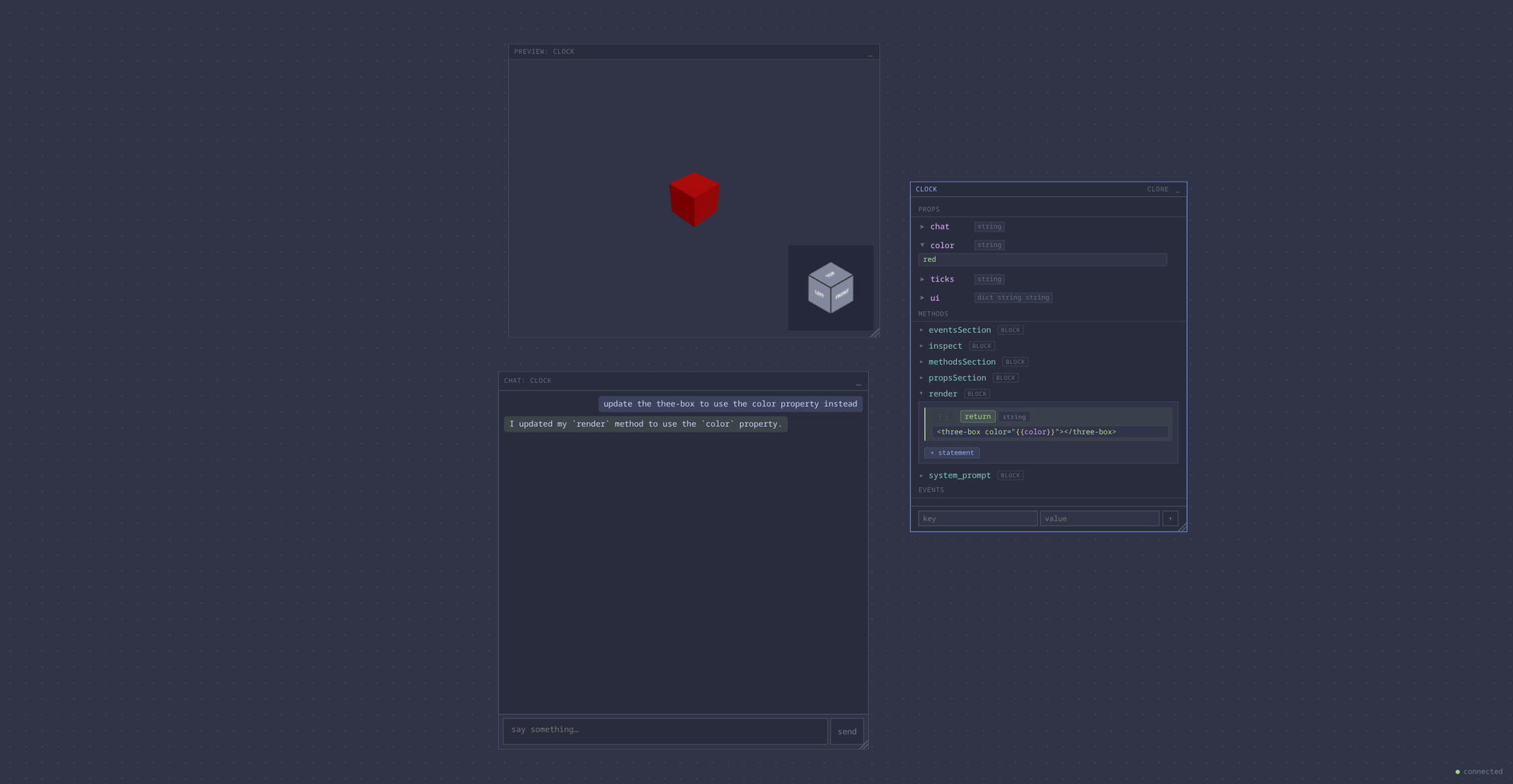
Talk to an object. It changes itself. The world updates in real time.
This screenshot depicts a Ting changing its internal behaviors and appearance based on the conversation with the user. This is not a mockup. It is the actual working prototype.
XR compatible
The editor works both on your laptop, phone, and in virtual reality.
A visual editor for living objects
Every object opens as a window. You see its data, its behavior, its events. Click to edit. Drag to rearrange. Everything saves automatically.
Every object is inspectable
Click on any object and its window opens. You see everything — its data, its behavior, its connections to other objects. Change a value and see the result immediately.
Talk to it
Every object has a chat interface. Ask it to change its color, add a new behavior, or explain what it does. It uses AI to understand your request and modifies itself.
Clone and modify
See an object you like? Clone it. Change one thing. Clone again. No classes, no templates. Just living copies you can customize. Like copying a document and editing the copy.
Objects live in 3D
Every object has a 3D form. It appears in a shared spatial world. Walk around your data. See your objects. Enter VR and stand among them.
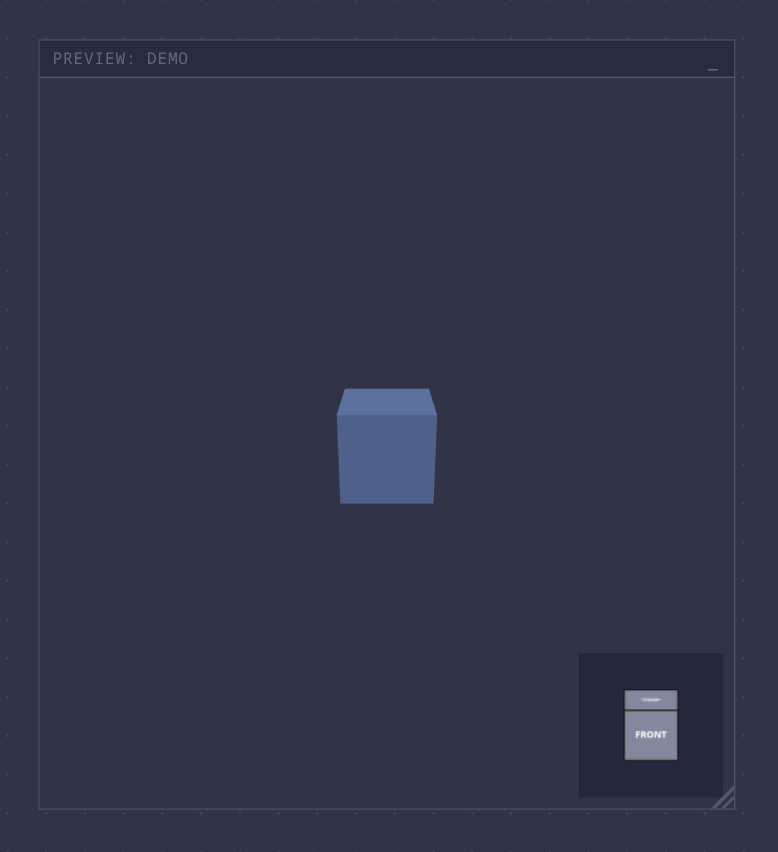
Screenshot from the actual editor.
Spatial computing
Objects aren't just data in a table. They exist in space. A chat bot is a sphere you walk up to. A database is a grid you can touch. A sensor is a glowing dot on a map.
VR ready
The same objects that render on your screen render in a VR headset. Put on a headset and you're standing inside your system. Reach out and touch an object to inspect it. The editor works in both flat and immersive mode.
Objects define their own look
Each object decides how it appears. A player might be a box. An enemy might be a red sphere. A weather service might be a cloud. Ask the object to change its appearance and it does — because the look is just another property it controls.
One command to run a world
Install the CLI. Create a world. Populate it with objects. Export the entire state as a single file. Send it to someone. They load it and everything is there.
A world in a file
Export captures everything — every object, every piece of data, every behavior, every connection. The result is a single HTML file. Import it anywhere and the entire system comes back exactly as it was.
No setup, no configuration
One binary. No Docker. No database server. No config files. Create a world and start building. Everything runs locally on your machine, or can be scaled across countless servers.
Or skip the world entirely
Have an HTML file? Serve it directly. No need to create a world first.
The protocol is HTML
Every tool that understands HTML can talk to bjorgxr. Browsers, AI models, other web services, scripts — they all speak the same language the system already uses.
No special client needed
Create a Ting from a script. Read its data from Python. Connect it to a spreadsheet. The API is standard HTTP — anything that can make a web request can control the system.
AI already understands HTML
AI models already understand HTML. That means every object in the system can be read, understood, and modified by any AI — no special integration, no custom tools. The language the system uses is the language AI already knows.
Every object is its own AI
The AI doesn't sit outside the system controlling it. Each object is an AI. It has its own memory and its own context. Thousands of small AIs, each responsible for one thing, each talking to the others through the same API any external service would use.
One protocol for everything
The file format is HTML. The API format is HTML. The communication protocol is HTML. There's nothing to translate, nothing to convert.
Software that rewrites itself
Ask an object to change and it changes. Not just data — its behavior, its appearance, its connections to other objects. While the system is running.
The editor is made of objects
The toolbar, the file browser, the canvas, the chat window, the color theme — each one is an object. There is no separate “editor application.” The editor emerges from the objects it contains. Change the objects, change the editor.
Talk to it, it changes
Every object has a chat. Tell it “make yourself red” and it updates its own color. Tell it “count faster” and it rewrites its own timer. Tell it “explain yourself” and it describes what it does in plain English.
Clone and evolve
Copy an object, change one thing, copy again. Every object can be the starting point for something new. No templates, no classes. Just living copies that can diverge.
The system grows while running
Objects create other objects. An AI object can spin up helpers and connect them together. No deployment. No restart. The system keeps running while it changes.
✅ Secure
✅ European
✅ Sovereign
Aligned with EU Web 4.0
The European Commission's Web 4.0 and Virtual Worlds strategy calls for open, secure, trustworthy digital spaces under EU law. bjorgxr is built for that future — no US cloud dependency, no foreign data access, no non-European AI required.
An app store for objects
Publish objects others can use. Install objects others have made. Like an app store, but for the building blocks of your world.
Objects are the packages
An object already carries everything it needs — its data, its behavior, its appearance. Publishing is just sharing. Installing is just adding it to your world.
One command
Fork anything
Like an object but want to change it? Install it, modify it, publish your version.
Version history
Every version of every object is preserved. See what changed, compare versions side by side.
Where this is going
bjorgxr is early. Here's what's coming.
VR / AR
Put on a headset and stand inside your system. Walk up to an object and talk to it. The same objects work on a laptop, on your phone, and in virtual reality.
Mesh networking
Connect bjorgxr instances across the internet, local networks, or radio. Objects on different machines talk to each other as if they are running on the same CPU.
Distributed computing
Spread objects across servers. The system decides which objects should be close together for fast communication. Endlessly scalable.
Voice assistant
Talk directly to any object, and have them answer you both in text and optionally with voice. You can tell them to modify themselves, to talk to another object, to set up a later event where they should do something, and more.
Multi-user by default
Collaborate on a 2D screen like in Figma, or walk inside a shared virtual world and see and talk to and collaborate with as many people as you like. Every person is also an object in the application.
Body tracking
Camera modules capture body movement and give every person a live 3D avatar. Walk into a room and you have a body.
Available today
The editor, runtime, and CLI are working. The system is in active development.
Why we're building this
Europe needs its own digital infrastructure. Not reliant on foreign powers.
Today, European businesses, governments, and citizens depend on American infrastructure for everything — office software, cloud computing, AI, communication. Their data crosses the Atlantic. Their compute runs under foreign law. Their AI models are trained on their data, outside their jurisdiction.
The EU is building an alternative. Euro-Office is replacing Microsoft. Sovereign cloud alliances are replacing AWS and Azure. The European Commission's Web 4.0 and Virtual Worlds strategy is charting a path toward open, secure, trustworthy digital spaces built on European values.
bjorgxr is part of that movement. A platform-as-a-service, a programming language, an editor, a virtual world, and a communication system — all in one. Encrypted. Hosted in the EU. No foreign access to your data. No dependency on non-European LLMs. Security first. Trust first. A stronger, sovereign Europe.
Bjorg
Bjorg comes from Bjørgvin, the old Norse name for Bergen, Norway. The word bjørg means protection, help, rescue in Scandinavian languages.
That is what we are trying to do — protection. For our data, our infrastructure, and Europe's digital autonomy. Safe from foreign interference.
Ting
The smallest unit in bjorg is called a Ting — Norwegian for “thing.” Everything you create, inspect, and interact with is a Ting.
The name is inspired by Self, the language that together with Smalltalk, prototyped OOP in a live system. Self called its objects for morphs, from the Greek morphē — “thing.” We did the same, as a tribute.
What we replace
How it works in practice
You create a world. You fill it with Tings. They start running.
Create a world
A world is just an HTML file. It contains objects. Run the server and your world is live.
Add things
Open the editor in your browser. Create objects by cloning existing ones or writing new ones. Give them props, methods, and a visual form.
They talk to each other
Objects send messages to each other. One object reacts to another. Every object is AI-powered and can think for itself. Chain enough of them together and you have an application, a game, a simulation, a business, an intelligent system.
Deploy it anywhere
Your world runs on any server. Host it in the EU. Share it with others. Connect it to other worlds. Everything stays under your control.